A production coordinator at a mid-size apparel brand can usually tell you exactly where the week went, and it is rarely the work they were hired to do. It goes to reconciliation. Matching a purchase order against a packing list, chasing a factory for a revised ship date, rekeying a size run because the wholesale portal exports it in a shape the ERP will not accept.
None of that is glamorous and none of it is optional. Apparel operations run on a dense stack of small decisions, and every one of them depends on data that lives somewhere else, in a slightly different format, updated on a slightly different clock. For a long time the fix was more people or more spreadsheets. Both fixes fail in roughly the same place, usually right when the business finally starts growing.
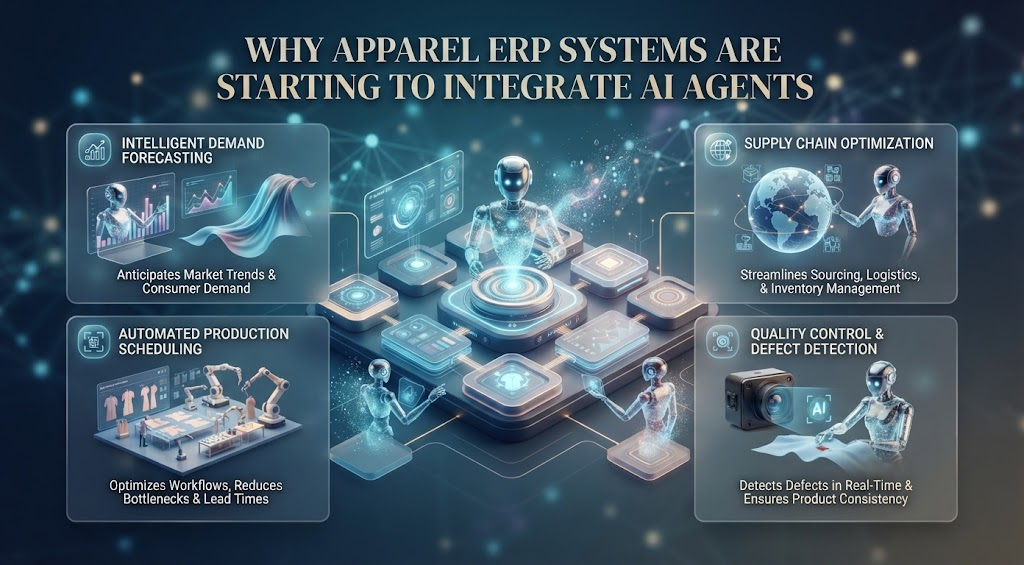
That pressure is behind a quiet change in how apparel software is being built. ERP vendors are starting to embed AI agents inside the system of record itself, instead of hanging a chat window off the side of it. The difference is bigger than the marketing usually makes it sound, and it is worth walking through what actually shifts.
Where Apparel Complexity Actually Compounds
Apparel carries a kind of complexity that most product categories never touch. Every style multiplies out across colors and sizes, so a single line item in a buyer’s head becomes forty rows in a system. Add wholesale, direct-to-consumer, and retail doors drawing on the same physical stock, and the number of allocation decisions per day climbs past what any coordinator can hold in working memory.
Then the calendar moves. Seasons overlap, samples come back late, a fabric substitution ripples through a costing sheet that six other documents were built on. The traditional ERP handled this by storing everything faithfully and asking a person to notice what mattered. Storage was never the hard part. Noticing was.
What an Embedded Agent Does Differently
A chatbot answers questions about data. An agent reads live records, applies a rule, and takes an action inside the same system that holds the truth. When a factory confirmation lands three days late, an embedded agent can flag the styles whose delivery windows just broke, recalculate what that does to open wholesale commitments, and draft the revised ship notice for someone to approve.
That is the practical argument for putting AI agents inside an apparel ERP rather than in a separate tool. An agent working from an export is always looking at yesterday. An agent sitting on the live tables sees the same numbers the finance team sees, with the same permissions and the same audit trail, which is what turns a suggestion into something a business will actually act on.
The Data Layer That Makes Agents Useful
None of this works on messy identifiers. If the same style carries three different codes across sales, warehouse, and purchasing, an agent will confidently reconcile the wrong things, and it will do it faster than a human ever could. Clean product identification is the unglamorous prerequisite, which is why the global identification standards maintained by GS1 matter more to an AI project than most software demos admit.
Brands that already enforced SKU-level discipline tend to see results within weeks. Brands that never did spend the first phase of any agent rollout cleaning up master data, and that work is not wasted, but it is worth budgeting for honestly rather than discovering halfway through.
Compliance Pressure Is Pulling Agents Into the Stack
There is a regulatory push here too. The EU’s Ecodesign for Sustainable Products Regulation introduces a Digital Product Passport that will carry material origin, repairability, and recycling information for physical goods, and textiles sit near the front of the queue. That information has to come from somewhere, and the somewhere is the ERP.
Material claims add another layer. Certification schemes run by bodies such as Textile Exchange require traceable documentation from farm to finished garment, and keeping that chain intact across dozens of suppliers is exactly the sort of patient, repetitive verification that agents handle well and people quietly hate.
The Judgment That Stays With People
Nothing in this replaces a merchandiser’s read on a trend or a sourcing manager’s instinct about which factory will actually hit a date. Agents are good at the part of the job that is bookkeeping wearing a costume: reconciliation, exception spotting, chasing the same three data points across four systems.
Choosing well still comes down to specifics, and the most useful evidence is usually detailed, first-hand accounts from teams who have run the software rather than vendor decks. Practitioners increasingly publish those walkthroughs on open tech platforms, which makes independent experience easier to find than it was five years ago.
Closing Thoughts
The shift toward agent-enabled ERP is not really a story about artificial intelligence. It is a story about apparel operations outgrowing the manual coordination layer that held them together, and about software finally being asked to do something with all the data it has been storing for two decades.
Brands that get value from it will be the ones that treat it as an operations project first and a technology purchase second. Clean the identifiers, decide which decisions a machine may make on its own, and keep a person on the ones that carry real commercial weight.
The rest tends to follow. Not dramatically, and not all at once, but in the form of a coordinator who spends Tuesday on supplier relationships instead of on a spreadsheet nobody outside the building will ever see.
Leave a Reply